
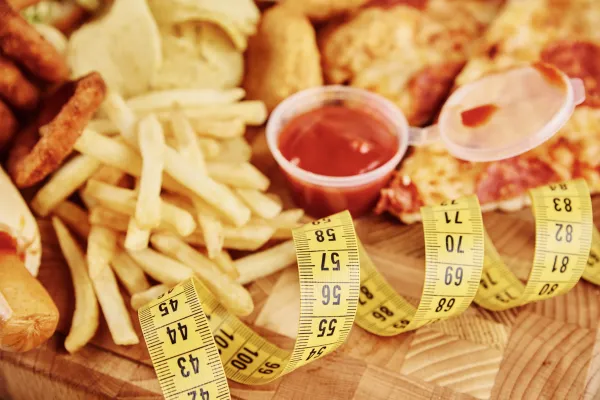
Do Processed Foods Increase Appetite and Lead to Weight Gain?
Transform Your Health
The Effect of Processed Foods on Satisfaction, & Sustainability
Appetite & Weight Gain: Why “just eating less” keeps failing in an ultra-processed world
1. The modern food environment is wired against us
Most people think weight gain is simply about willpower—eat less, move more. But the reality is that our everyday food environment is engineered to make us eat more than we intend, especially when it’s dominated by ultra processed foods (UPFs): packaged, convenient products that are heavily reformulated, flavored, and textured to be hyper‑palatable.
Over the last few decades, UPFs have gone from occasional treats to the backbone of many diets. According to data from the FDA, about 60% of the food Americans eat are from processed and ultra processed foods. At the same time, rates of overweight and obesity have climbed almost in parallel. The big question researchers are now asking is: do ultra processed foods themselves drive overeating and weight gain—even when calories and nutrients look “matched” on paper? (Hint: the answer is Yes!)
Can Ultra-Processed Foods Be Fixed by Tweaking Their Nutrients?
2.What counts as “ultraprocessed”?
UPFs aren’t just “junk food.” They’re defined by how they’re made:
Industrial formulations: multiple ingredients you wouldn’t use in a home kitchen (emulsifiers, flavor enhancers, colorings, stabilizers).
Heavily refined bases: flours, sugars, and oils stripped of fiber and texture.
Hyper‑palatability: engineered combinations of sugar, fat, salt, and texture that make foods easy to eat quickly and in large amounts.
Think: sweetened breakfast cereals, packaged snacks, soft drinks, instant noodles, many frozen meals, and fast‑food items. These foods are designed to be convenient, tasty, and hard to stop eating—exactly the conditions that challenge appetite control.
3. How ultra processed foods increase appetite and energy intake
"Sweet Lies"
Artificial sweeteners confuse the brain:
Splenda, Equal, Truvia,100–200x sweeter than sugar – leads brain to compensate
Body responds by craving more protein and fat. Animal studies: Rats fed artificial sweeteners ate more than those fed natural foods.••Suggests sweeteners disrupt appetite regulation.
Recent work has shifted from “UPFs are associated with obesity” to “how, exactly, do they make us eat more?” Several mechanisms keep showing up:
Reduced chewing and faster eating: A 2024 randomized crossover trial found that when overweight men ate diets composed of ultra processed foods versus non‑ultra processed foods—matched for calories and macronutrients—they gained more weight and ate over 800 extra kcal per day on the UPF week. One striking detail: they chewed less per calorie when eating UPFs. Less chewing means faster eating, weaker satiety signals, and more energy consumed before the body can say “I’m full.”
Texture and structure: “soft calories” UPFs are often soft, easy to swallow, and low in fiber. This reduces gastric distension and slows the mechanical feedback (the feeling of being full) that normally helps shut down appetite. Foods that require more chewing and have intact structure (whole grains, whole fruits, minimally processed meals) tend to promote earlier fullness at lower calorie intakes.
Hyper‑palatability and reward: UPFs combine sugar, fat, and salt in ways that strongly activate reward pathways. This can override normal homeostatic appetite control, nudging people to eat for pleasure rather than need. A 2023 critical review of mechanisms linking UPFs and obesity highlighted reward, palatability, and energy density as central drivers of increased intake.
Calorie density and “hidden” energy: Many UPFs pack a lot of calories into small volumes. When foods are energy‑dense but don’t feel heavy or filling, people can easily overshoot their needs without realizing it.
Disrupted appetite hormones: Emerging evidence suggests UPFs may alter the secretion or timing of hormones like GLP‑1, PYY, and ghrelin, which regulate hunger and fullness. While this area is still developing, reviews in endocrinology now argue that UPFs likely contribute to obesity through combined effects on appetite regulation, reward, and metabolic responses.
Taken together, UPFs don’t just add calories—they change how we eat and how much we want to eat.
4. What the latest research is showing
Controlled trials now show causation, not just correlation. In the 2024 crossover study, participants gained about1.1 kg more during the UPF week and consumed~800 kcal more per day, despite meals being matched for total energy and macronutrients on paper. The difference came from ad libitum intake—people simply ate more when the food was ultra processed.
Mechanisms are being mapped out. The 2023 review on UPFs and obesity risk catalogued mechanisms including faster eating, higher energy density, lower fiber, stronger reward signaling, and potential hormonal effects. The conclusion: UPFs create a “perfect storm” for overeating and weight gain.
Major journals now frame UPFs as a core obesity driver. Recent high‑level reviews in endocrinology argue that reducing UPF intake is a key strategy for obesity prevention and treatment, not just a lifestyle “nice‑to‑have.”
5. Summary
Prioritize foods that make you chew. Whole fruits, vegetables, intact grains, nuts, and home‑cooked meals slow eating and strengthen fullness signals.
Use UPFs as “accessories,” not the base of your diet. If a meal is mostly from a package and ready in under 3 minutes, it’s likely ultra processed. Aim for those meals to be the exception, not the rule.
Watch “soft calories”: drinks, snacks, and desserts. Sweetened beverages, ice creams, pastries, and many snack foods deliver large amounts of energy with minimal satiety.
Think environment, not willpower. he science shows UPFs are designed in ways that push us to overeat. Shifting your default foods toward minimally
Dear Subscriber,
After a 3-month hiatus, I am back to producing my monthly Transform Your Health newsletters. This newsletter is Part 2 of my previous newsletter" Can Dietary Supplements Slow Ageing and Improve Health". You can access it again by clicking on this link.
Yours in Good Health
Salvatore
600 1st Ave, Ste 330 PMB 92768, Seattle, WA 98104-2246
Processed options are more effective than relying on constant self‑control.


